When Missing Transparency Invalidates Shareholder Decisions
Transparency obligations relating to beneficial ownership are a key element of Swiss corporate governance. In this decision, the Swiss Federal Supreme Court confirms that failure to comply with GAFI disclosure obligations may lead to the suspension of shareholder rights and even to the nullity of shareholders’ resolutions. The judgment highlights the strict consequences of non-compliance and the increasing importance of transparency requirements for companies and boards of directors.

Background
At an extraordinary shareholders’ meeting of A. AG held as a universal meeting, B. was removed as sole board member and D. and E. were newly elected to the board of directors. The meeting was attended solely by C.C., who claimed to be the company’s sole shareholder. The corresponding changes were subsequently registered in the commercial register.
B., the former board member, challenged the validity of the shareholders’ resolutions pursuant to Art. 706b CO. The key issue was whether C.C. had complied with the disclosure obligations under former Art. 697i ff. CO regarding bearer shares and beneficial ownership and was therefore entitled to vote at the meeting.
Court Decision
The Swiss Federal Supreme Court summarized the former disclosure regime under Art. 697i ff. CO, applicable between 1 July 2015 and 30 April 2021. Under these provisions, any person acquiring bearer shares in a non-listed company had to notify the company within one month and disclose their identity and address. In addition, beneficial owners reaching or exceeding the threshold of 25% of the share capital or voting rights had to be reported pursuant to former Art. 697j CO.
The Court found that C.C. had failed to comply with these disclosure obligations. As a result, the membership rights attached to the shares, including voting rights, were suspended pursuant to Art. 697m CO. Since no valid votes had been cast at the universal shareholders’ meeting, the resolutions adopted there were null and void.
Implications
The judgment illustrates the strict legal consequences of failing to comply with GAFI-related disclosure obligations. The suspension of shareholder rights may result in the invalidity or nullity of shareholders’ resolutions, even where corporate changes have already been registered.
The decision is also highly relevant in light of the forthcoming Federal Act on the Transparency of Legal Entities and the Identification of Beneficial Owners (TJPG), expected to enter into force in 2026 or 2027. Under the new regime, boards of directors will be required to identify beneficial owners, maintain the relevant information, and report changes to the central transparency register within the statutory deadlines. Violations may lead to fines of up to CHF 500,000. The judgment therefore emphasizes the growing importance of transparency and compliance obligations for boards of directors.
 Board Cases
When Delayed Bankruptcy Creates Liability
Boards of directors must act swiftly when a company faces financial distress. In this decision, the Swiss Federal Supreme Court confirms that delaying bankruptcy proceedings may result in personal liability for board members if the delay causes additional losses to the company. The judgment underlines the importance of timely action under Art. 725 ff. CO and reinforces the board’s duty to monitor solvency and over-indebtedness carefully.
 Board Views
Striving for Excellence in Venture Governance
The contribution of the venture board to entrepreneurial value creation, and its pivotal role in venture ecosystems, is often overlooked despite a long history of venture governance. History teaches us six principles of excellence in venture governance.
 Board Views
The Promise and Perils of Agile Governance
Agility as a leadership principle has gained enormous importance in recent years. Many companies proclaim agility as a new leadership culture that is better aligned to future opportunities and challenges. At the same time, companies must adhere to corporate governance principles, some of which conflict with agility principles. This article presents considerations for improving the compatibility of agile leadership principles with the principles of effective corporate governance.
 Board Views
From Corporate to Ecosystem Governance
Mastering ecosystems is increasingly seen as key to strategic value creation in highly dynamic environments. The role of governance has become a key differentiator between organizations that win or lose from the ecosystem game. This article discusses the importance of governance to the successful creation, development, and growth of ecosystems and presents eight challenges to be addressed along the ecosystem lifecycle. It continues with a taxonomy of ecosystem governance that provides a menu of effective governance mechanisms to address these challenges. The article concludes with advice on how best to manage the transition from a corporate governance to an ecosystem governance focus.
 Board Cases
When Mandates Expire
The term of office of the board of directors and the statutory auditor is essential for effective corporate governance. The Swiss Federal Supreme Court clarifies that de facto organs may not convene shareholders’ meetings and that the auditor’s term of office must be assessed differently from that of board members. The judgment therefore provides important legal certainty in practice.
 Board Books
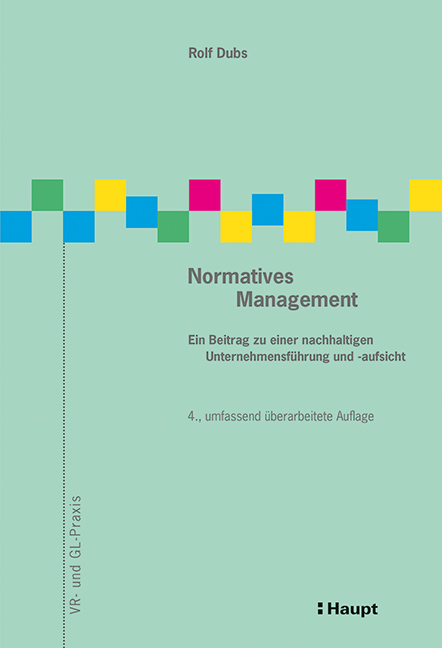
Normatives Management
Die globale Finanz- und Wirtschaftskrise hat wachgerüttelt und gezeigt, dass sich für die Unternehmensführung ein neues Management-Modell aufdrängt, das nicht mehr vom Prinzip der Gewinnmaximierung, sondern von einem «Gewinn unter Nebenbedingungen», d.h. unter der Annahme einer realistischen Berücksichtigung von Anliegen und lnteressen aller Anspruchsgruppen, ausgeht. Diese Nebenbedingungen umfassen dabei alle jene Kriterien, die über die rein ökonomische Maximierung hinausgehen und die Nachhaltigkeit sowie die Corporate Social Responsibility definieren und sicherstellen. Sie bilden die Grundlage für das normative Management, das bewusst in die strategische Planung in der Unternehmung einzubeziehen ist.