When Governance Ends through Inaction
Boards of Directors face a structural tension regarding mandate duration. While legal requirements clearly define the role of the general meeting and term limits, in practice these rules are not always consistently applied, leading to uncertainty and de facto extensions. The Federal Supreme Court decision clarifies that governance cannot be prolonged through inaction and that the general meeting must actively exercise its authority. Effective governance depends on clear accountability and functioning institutional processes, not on habit.

Background
This decision BGE 148 III 69 (4A_496/2021) forms part of a series of rulings (4A_387/2023, 4A_429/2023 and 4A_508/2023) addressing the duration of board mandates in light of statutory requirements and corporate practice.
The case concerns a company whose board members were elected for a one-year term, ending at the next annual general meeting. Under Art. 699 para. 2 CO, such a meeting must be held within six months after the end of the financial year. In the present case, however, no general meeting took place for several years.
Against this background, the central issue was whether the board members elected in 2019 remained in office or whether their mandate had already expired. Specifically, the question arose whether a board mandate can be implicitly extended in the absence of a general meeting, or whether it necessarily lapses after the statutory deadline.
Court Decision
The Federal Supreme Court addressed differing doctrinal views on the duration of board mandates. While some argue that mandates continue until the next general meeting, others support a strict temporal limitation.
The Court relied on a core governance principle: the election of the board is a non-transferable right of the general meeting. This competence must not be undermined by inaction. Allowing the board to extend its mandate by not convening a general meeting would impair shareholders’ rights.
Accordingly, the Court held that the board’s mandate expires no later than six months after the end of the financial year if no general meeting is held or if the election is not on the agenda. An implicit extension is excluded.
Implications
The decision confirms that corporate governance is based on formal legitimacy rather than practice. It reinforces the role of the general meeting and limits informal extensions of board mandates.
Failure to hold the general meeting in time under Art. 699 para. 2 CO may lead to an organizational deficiency within the meaning of Art. 731b CO if no valid board remains.
The decision also shows that the term of office is strictly tied to the statutory framework—particularly Art. 699 para. 2 CO—and that governance reaches its limits where key processes are not observed. Compliance with deadlines and procedures is essential for the company’s legitimacy and proper functioning.
 Board Cases
When Delayed Bankruptcy Creates Liability
Boards of directors must act swiftly when a company faces financial distress. In this decision, the Swiss Federal Supreme Court confirms that delaying bankruptcy proceedings may result in personal liability for board members if the delay causes additional losses to the company. The judgment underlines the importance of timely action under Art. 725 ff. CO and reinforces the board’s duty to monitor solvency and over-indebtedness carefully.
 Board Views
Striving for Excellence in Venture Governance
The contribution of the venture board to entrepreneurial value creation, and its pivotal role in venture ecosystems, is often overlooked despite a long history of venture governance. History teaches us six principles of excellence in venture governance.
 Board Views
The Promise and Perils of Agile Governance
Agility as a leadership principle has gained enormous importance in recent years. Many companies proclaim agility as a new leadership culture that is better aligned to future opportunities and challenges. At the same time, companies must adhere to corporate governance principles, some of which conflict with agility principles. This article presents considerations for improving the compatibility of agile leadership principles with the principles of effective corporate governance.
 Board Views
From Corporate to Ecosystem Governance
Mastering ecosystems is increasingly seen as key to strategic value creation in highly dynamic environments. The role of governance has become a key differentiator between organizations that win or lose from the ecosystem game. This article discusses the importance of governance to the successful creation, development, and growth of ecosystems and presents eight challenges to be addressed along the ecosystem lifecycle. It continues with a taxonomy of ecosystem governance that provides a menu of effective governance mechanisms to address these challenges. The article concludes with advice on how best to manage the transition from a corporate governance to an ecosystem governance focus.
 Board Cases
When Mandates Expire
The term of office of the board of directors and the statutory auditor is essential for effective corporate governance. The Swiss Federal Supreme Court clarifies that de facto organs may not convene shareholders’ meetings and that the auditor’s term of office must be assessed differently from that of board members. The judgment therefore provides important legal certainty in practice.
 Board Cases
When Missing Transparency Invalidates Shareholder Decisions
Transparency obligations relating to beneficial ownership are a key element of Swiss corporate governance. In this decision, the Swiss Federal Supreme Court confirms that failure to comply with GAFI disclosure obligations may lead to the suspension of shareholder rights and even to the nullity of shareholders’ resolutions. The judgment highlights the strict consequences of non-compliance and the increasing importance of transparency requirements for companies and boards of directors.
 Board Books
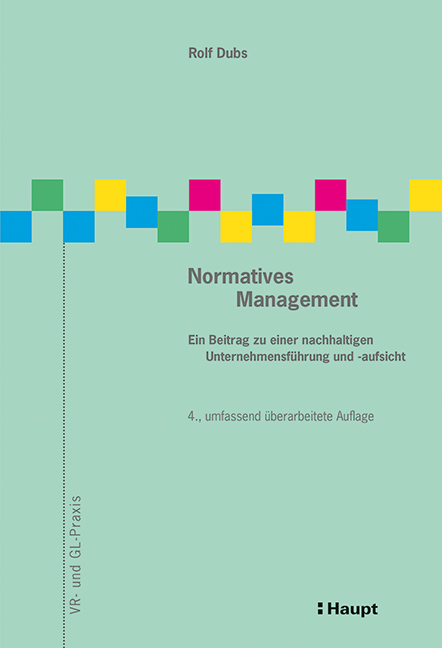
Normatives Management
Die globale Finanz- und Wirtschaftskrise hat wachgerüttelt und gezeigt, dass sich für die Unternehmensführung ein neues Management-Modell aufdrängt, das nicht mehr vom Prinzip der Gewinnmaximierung, sondern von einem «Gewinn unter Nebenbedingungen», d.h. unter der Annahme einer realistischen Berücksichtigung von Anliegen und lnteressen aller Anspruchsgruppen, ausgeht. Diese Nebenbedingungen umfassen dabei alle jene Kriterien, die über die rein ökonomische Maximierung hinausgehen und die Nachhaltigkeit sowie die Corporate Social Responsibility definieren und sicherstellen. Sie bilden die Grundlage für das normative Management, das bewusst in die strategische Planung in der Unternehmung einzubeziehen ist.